Measuring your small business
Math, Measurements, metrics
Math sucks. Fundamental to almost all modern science it sucks and it’s no sucks to do or learn. It means that we often avoid it as much as possible after we leave the mandatory school lessons. Those of us that enjoy math usually go on to do something with that joy, however the remainder try to spend our time avoiding it. Unfortunately, as Benjamin Franklin said about certainties in life being, death and taxes we, all must deal with math at some stage in our lives.
It is very common for businesses of any size be it owner operator or corporation to have a lack of focus and understanding of their math, their numbers, and their impact. It’s been a career eye opener for me as a corporate staff member of 20 years to understand how little big corporations understood their math. There is some solace to be found in that idea that the big guy in the business market is a bound by and hostage to the same numbers you are.
In that light we want to take a moment to outline some basic and starting metrics and measurements of your business that will help you get some insights as well as provide some suggestions on how to look at the data as well as suggestions on what that data might tell you.
One quick word on collecting information or data, you can do that in any tool you like, this activity is more about making sure you’re capturing data and you’re using it then the tool in which you do it. So, start with any of a range of free and easy to use options. Google Sheets, or similar spreadsheets are perfect starting points. There is more advanced software you can deploy or may have access to that can help with that but here we want you to start tracking and doing more than being fancy with it.
We’ve grouped the metric below in batches so you can read them in any order or refer to them at any time.
Doing the business, or are we?
You’re making your things, you’re selling, and the clients are buying. This is a great thing, right? It is yes of course, and we want to make sure that we’re using the information that your sales are creating for you. There is a lot of interesting information in that sales data, and we want to give you some simple ideas on what to look for in your sales data.
Data Capture
What information should you be capturing and tracking to understand your sales. We recommend starting with a simple spreadsheet that captures the following details.
Data headers
Sales date (When did it happen)
Sales item (What was the item, a name or description)
Quantity of that item (how many of the item you sold)
Customer identifier of a sort (Customer Name, or type)
Where you sold the item (online, market, store XYZ, etc.)
What price did you sell the item for?
We recommend you do it with one row per sales Item.
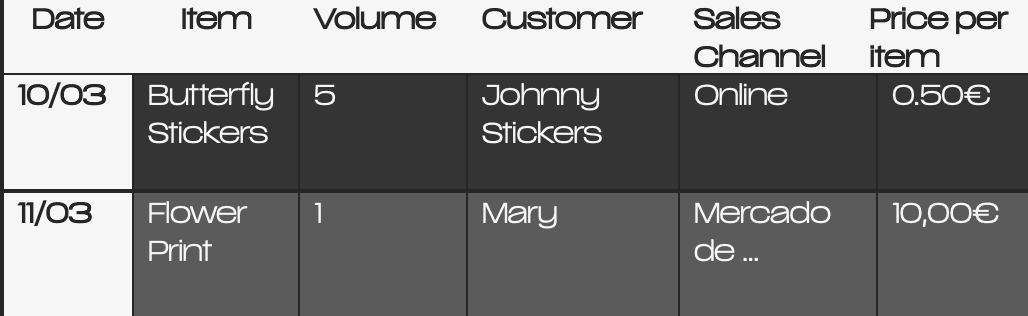
Table 1. Sales Spreadsheet outline
You’re now collecting sales data in a format that allows you to see a whole bunch of very interesting information in simple way. Capturing this data can be a bit hard to start with and any information is better than nothing so doesn’t think this is the only way to achieve the benefits of this. Also remember that small steps are steps all the same.
Now let’s flip some tables - Spreadsheet tables that is.
With a range of information like this you can now see some of the following things.
What am I selling?
Filter on your item column and you’ll get an overview of what items are moving more then others. Are any specific products or items showing up a lot more than others? Then you have a hit on your hands, and you can focus on more of that product or theme. You can try to ensure you have enough of these products on hand for sales.
You can also see what is not selling, by taking note of what is not on your list here. Any products or items not on the list might not be hitting your clients. Maybe they don’t know about them and need more marketing, or perhaps the audience needs to change for the efforts. Maybe they can be reviewed for new ideas or changes to the product. What’s not on the list may need work or marketing.
Now you’ve just with a simple filter on the column understood what you are doing well, and what you can put attention on. You can see what your customers are liking and what isn’t really hitting the mark.
Who is buying your stuff
Who - Filter on your customer list and you’ll see who is buying your products. Who is your best customer, who are you getting the most traction with. Are stores, your best customers, or Is it individuals.
Frequency - You can also how often they are buying with the date field. Are the customers repeat customers or only singular purchases. Is it monthly or weekly. Has a major customer not purchased in a while, you can reach out to them and say hi?
What – Now you can look at your clients’ buying habits and see what resonates with the clients, what does your biggest customer buy? Is that the same as other customers? Maybe your biggest customer is only taking your one product, and you can suggest the other items that might complement the orders. Suggesting to a customer other item of a similar nature to what they are already interested is a great way to expand your relationship with that client.
Where are they buying my stuff?
So now let’s filter on the sales channel. This is going to tell us where we are selling our products. I imagine many of our readers here will be doing a range of sales areas, such as markets, online stores, etsy, directly to stores and any of a hundred different paths. Having an idea of where you are getting the most of your sales through is critical to understand a range of key decision points.
What is my biggest sales channel, where do most of you orders come from? Are you selling more online or at markets? Where is most of your income coming from, and what is the second and third most? Are you doing a lot of work at markets and not so much online? Maybe your customer doesn’t know about your online store? Are the online orders coming in but the Etsy store not doing the work? Maybe focus on one online store instead of several? Additionally knowing how much work you must make each sale is very important. Perhaps you make some sales at markets but it’s also costing a lot of time, where online is fast and simple making it cheaper to sell on? Making decisions on where to focus your products and sales channels is a ongoing decision so be ready to and happy to change, mix and stop any that don’t work for you and your goods. Walking away from a decision is a powerful decision.
How are my prices?
So now we want to focus on our last column where we can see the prices and what you’re making. The key focus here is to understand what we are charging for each item and are we ensuring that our costs and costs of sales are being covered.
On Department45.eu we have a full article on how to make sure you’re setting the right prices
Notice here if you have room to adjust your prices, do you have your prices consistent across all platforms? Are some items selling a lot because we have a price too low on them? Should items that are not selling be discounted?
Prices are adjustable and flexible, play with your pricing to find the level that covers all your costs, and ensure any discounts and additional costs of sales are included in pricing. You can have a lower price in markets because you don’t need to pay for shipping packaging or similar, for example.
Keeping track and checking your data
Now we have a body of data in our spreadsheet. We know what we’re looking for in the data, and we’re making decisions out of the data. We are playing with our product mixes our sales channels and our prices. The next question is how often we should be looking at this data, and how we should maintain it.
For the data to work you need to maintain it. That means keeping an ongoing track in the spreadsheet of your sales and that data is a good habit to keep and have. Even if you’re not looking at the data daily, you need to keep adding it to have a benefit of it. Make a habit of entering on a daily weekly basis your sales to the spreadsheet. Build it into your process, when the sale comes in you track it on the spreadsheet before shipping the order. Or take small notes by hand at the market and enter it into the spreadsheet in a quiet moment after. Without the data we don’t know what’s going on, except on gut.
How often to review the data and make decisions is really a question you’ll best answer based on the type of business you have. If you sell many small transaction items and have a large product base you may need to look often to match production and stock ordering with what is being sold. However, if you have few larger sales, it might be more relevant to check monthly on who is ordering and follow up with clients that may have forgotten to order.
The general suggestion is to check your data as often as you fell you have something to learn from it. Learn what your business is doing, and you’ll make better decisions.
I appreciate your time and attention, if you have questions or comments, please leave them below or on our Instagram @department45.eu. If you’re interested working with us on looking at building your business routines, then reach out to us at timh@department45.eu