Selling online – Analysis Method
Editor note - This article is a complementary article for our Online retail article “Finding the best online Retail tool. ". This seeks to explain our analysis method and process.
Online Retail
I would imagine most people who follow my blog here will be common shoppers online and would have extensive experience using and browsing many sites for goods and services. The fact that we’re becoming more and more comfortable and familiar with shopping online has changed and developed many companies model of selling and engaging with their clients. For most companies the biggest expense they will have will be the cost of a location and online retail takes the need for brick-and-mortar locations away. It enables commerce at any level as well, with a great deal of small home businesses to get some manner of reach which previously would have been impossible with only face to face sales.
That’s why more and more the online sales are expected to grow and expand 30% of the global population is shopping online and about 20 % of retail revenue is online as well. This means that having a good tools and online store strategy is important to any business that is selling online.
We’ve looked at a range of online selling portals, marketplaces tools and done a comprehensive analysis of what they offer, what they cost and what might be the best choice for your business existing or otherwise. Our study has shown that the costs, can vary greatly as well as the simplicity of use which are important for any business as they grow into their market.
We have developed the analysis below based on reviewing a range of 13 different vendors, by comparing prices features and other elements of their offering. We’ll then present these comparative clients to a set of three company scenarios to discuss which of the options provides the best features and values for that scenario.
Framing the Analysis
The analysis we’ve built up for this comparative study has been built up to both. identifying initially the key marketplaces, retail software vendors, and market channels that small businesses use today. Then we built up a series of comparative data points to capture across each vendor to allow for a comparative analysis of which vendor presents the best options and features for a given set of clients. Also helping us to illustrate the financial impact to choosing these different vendors. We want to ultimately give a set of recommendations and risks associated with these platforms’ comparative to a handful of Small business scenarios.
Initially we identified thirteen platforms we wanted to investigate. These include fully established marketplaces where the vendor sells on the marketplace site – Amazon, Etsy, eBay, Olx.pt. Multiple websites hosted shopping tools – Shopify, Wix, SquareSpace, Shopk.it, finally sought the newer direct plugins of Social Media markets such as TikTok Shop.
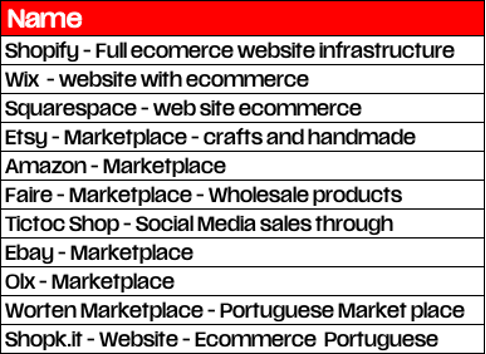
List of Marketplaces and e-commerce vendors reviewed.
The Markets
The tools and sites that we have reviewed fall into three specific types. We’ve classified them as Marketplace’s, Ecommerce websites, and Social Media. Each has different core features that differentiates them significantly that we want to briefly touch on.
Marketplaces
The marketplaces are the easiest to classify, These are large known, sites, that will host your products, even allow for some branding, on their own websites. If you’re selling on Amazon, it’s your store on amazon, but it’s amazon’s site. Your products will be visible, and many give a degree of branding and marketing space for your own products, but the site will be theirs. How the site works, how the products are presented, how the SEO on the site works, what other products or brands your products will appear next too you’ll have no control over. Additionally, the URL of the site will never be yours. The upside of these large marketplace lies in their scale, marketing, and brand recognition. Amazon, eBay, and Etsy are synonymous with online retail, and often the first site anyone will visit for their specific general area. The overall scale of their marketplace can drive a base minimum of users and traffic past your products with you having to do very little in marketing or SEO. You’ll have to fight the SEO within the site to ensure you rise to the top of their internal search features but still each of the largest marketplaces come with an inherent audience. The marketplaces that we researched for this analysis included.
Etsy – A global online retail leader that in 2024, had over 5.6 million vendors, selling to 95 million customers for over $12.6 billion. [1] It is known as the handmade, cottage industry small business portal.
eBay – Online auction and secondhand market, eBay has become the place to go to sell and buy new and used items. eBay claims between 18-20 million sellers that retails for almost $75 billion dollars in sales in 2024. [2]
Amazon – We all know amazon, love It or hate it. The site is the definition of online retail and for most markets the first place many go to for their online shopping. They have over 1.9 million sellers[3] with these 3rd party vendors being responsible for most sales.
Olx.pt – is part of the Olx brand of classified marketplace where anyone can put of their products to sell, with a direct vendor to client model this is the leanest of our analysis. The Portuguese site sees about 2.6million hits a month[4].
Faire – This is an interesting marketplace as this is targeted B2B or business to business with a focus on wholesale orders to retailers. Giving artists and people to wholesale their products. Over 100,000 vendors and sales over $3 billion[5] show it’s growing strength.
Worten Marketplace – Worten marketplace is a large Iberian online platform that allows many brands to sell their items. With a local focus to Portugal and Spain we included this into our analysis.
E-Commerce Websites
E- commerce websites, allow a brand to create their own retail site, built around their own brand messaging and marketing. The full control of content, marketing and site build along with the choice of how things are presented come with the power of the e-commerce website’s built in inventory management, payment systems, and wide range of analytics. Key here is the control and brand messaging which the marketplaces limit. We’ve looked at four of these e-commerce tools providers.
Shopify – Shopify is one of the biggest ecommerce providers, and like many of these providers gives a wide range of features that makes getting online with a brand and selling very quick and intuitive, over 5 million storefronts[6] are powered by Shopify.
Wix E-Commerce – Wix has been commonly known as website builder, providing a quick template based and HTML free way to get your website set up. They also have an E-Commerce feature they offer with the website builder. 4.7 million sites[7] are built with Wix E-commerce features.
SquareSpace – E-Commerce, like Wix, Squarespace is a website builder that includes E-Commerce features, and allows like the other two ways to include retail into the template website building. Small at about 88,000 e-commerce websites.[8]
Shopk.it – A Portuguese inhouse built e-commerce website builder, they provide localized support and features for local payment options with a focus on the Portuguese market. Small but growing we’ve included them due for a Portuguese focus in this article. Per their own website over 53,000 brands[9] currently use them to support their e-commerce options.
Social Media Shop
Shopping through social media has become a bigger and bigger piece of the online retail space as brands continue to get into the space where people spend their time and plenty of that is on social media. As these social medias evolve age and grow the tools within them to enable ecommerce tools grows as well. With Facebook Marketplace being a classic classifieds opportunity for point-to-point selling, Tiktok shop has shown a great ability to launch viral moments for brands creating massive sales in minutes due to the winds of fickle virality.
Tiktok shop – We reviewed Tiktok shop as part of this as a sole social media shop in this. Over 15 million Global sellers, retail sales in the 20+ billion,[10] Unfortunately Tiktok shop is not available in Portugal as of writing Jan. 2026, and therefore we couldn’t review this as a possible option for a Portuguese vendor.
The Comparative
While looking at the thirteen vendors and platforms for this analysis we created a list of criteria and topics to pull out of their websites to form the basis of our analysis.
Premise - Portuguese & Entry Level
We always selected the entry or lowest or cheapest level of support subscription tier that a provided allowed. Many sites had scalable features and benefits trigged at higher monthly subscriptions but to allow for the best comparative we decided to always use the entry level tier of all websites.
As we are based in Portugal, we also wanted to review the vendors from the premise of a Portuguese based vendor. That means if a site or provider has limitations or features for Portuguese vendors, we would be looking for that. Noteworthy here is that Tiktok shop is not available currently in Portugal which prevented us from continuing the review of that feature for comparison. Even though it seems there is some way of doing sales in Portugal via a Brazilian back door. We’ve chooses not to do that.
Comparative
The key features we reviewed each site for follow an outline of both costs, as well as ease of use and more.
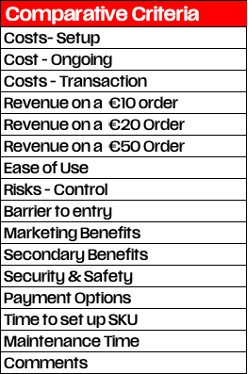
List of analysis criteria.
Cost – Setup, this is to outline what upfront costs, or one-time costs there may be with setting up the shop, this may be a one-off payment, or initial additional cost as part of the setup of the storefront.
Costs – Ongoing, this is the reoccurring costs, subscriptions, hosting costs, etc. which many or most of the websites have. These are mostly monthly and based on subscription tiers.
Costs – Transaction, here we outline the costs that apply for each actual sales, this is commonly commissions, fees the site takes of the sales, or credit card transaction fees, from the payment provider. Other fees that are entirely based on the sale or submission of a product line are outlined here.
Revenue on a €10 Order, is where we apply the costs, outlined before, and apply them to see how much revenue would be left after all fees and charges are applied.
Revenue on a €20 order, is the same as above but for a €20 order,
Revenue on a €50 Order is the same as above outlining the remainder on a €50 euro order.
Ease of use – seeks to outline how easy the tools or provider is to work with. Calling out features or support they provide or don’t to get your business online faster, simpler.
Risks and Control, being on a third-party website marketplace or even using an ecommerce vendor, the site is not entirely our own. We have a risk specifically in the Marketplaces of losing our accounts either to hackers, to changes in the website’s functionality, the political climate and more. These risks are reviewed here.
Barrier to entry is where we seek to outline what, if any, requirements the website or provider might need you to provide before you can work with them or get access to their site. For example, all the e-commerce sites will require you to purchase a domain to host your site under. This is required and can be done through their sites easily, but it is a barrier as without that purchase you cannot continue that journey.
Marketing Benefits, we call out any specific benefits that come from being on that marketplace beyond just your own brand. This can be through large campaigns the brand themselves do or through the brands own name recognition.
Secondary Benefits is there to callout any specific benefits, the vendor or provide gives at the tier we’ve selected that may help or support the retail experience or features.
Security and safety are a critical point of review where we’ve sought to understand what features the vendor has in place to maintain and combat hacking, hijacking and fraud.
Payment options outlines what means by which the vendor allows payments to be received. Many of the sites allow for most payment methods but some are limited on regional options or similar.
Time to set up a SKU, we’re looking at the time here that it on average takes to set up a listing. This Stock Keeping Unit (SKU)
Maintenance time. Here we’re seeking to call out if there are any specific time requirements that the site needs to maintain or support.
Comments are just comments.
The Method
Having outlined what we were going to review in our marketplaces, and providers, and knowing what criteria we were going to search for along with the premise we were looking for. We proceeded to review each offerings websites, terms and conditions, their FAQ’s and support sites. To collate the data, we have in the following analysis outline.
Summary
With our analysis method outlined above we wanted to clearly show our work, in the interest of transparency and to show how we at Department45.eu work. We recommend reading our lead article – Selling Online – Tools and Strategy to see the output of our analysis as well as the recommendations that it has created.
Thank you for your time and if you want us to bring our experience and analytical sense to your businesses’ challenges then why not reach out to us on our email, timh@department45.eu or on our Instagram, and schedule your free first consultation session.
Thank you for your time,
Tim H.
Lead consultant.
Links:
[1] https://investors.etsy.com/company-information#:~:text=Key%20Figures,completed%20the%20sale%20of%20Reverb.
[2] https://thunderbit.com/blog/ebay-statistics
[3] https://www.edesk.com/blog/amazon-statistics/#:~:text=Amazon's%20sales%20revenue%20is%20set,is%20worth%20over%20$1.8%20trillion .
[4] https://help.olx.pt/olxpthelp/s/article/nmero-mdio-mensal-de-destinatrios-ativos-do-servio-monthly-active-recipients-informao-de-fevereiro-de-2023-V0
[5] https://www.faire.com/news/2025-11-17-a-milestone-for-faire
[6] https://www.chargeflow.io/blog/shopify-statistics#:~:text=Historically%2C%20~9.3%20million%20websites%20have,Shopify%20in%20Q4%202024%20alone.
[7] https://trends.builtwith.com/shop/Wix-Stores
[8] https://wiserreview.com/blog/squarespace-statistics/
[9]https://shopk.it/showcase#:~:text=Alguns%20exemplos%20das%20nossas%20lojas%20*%2053.455,loja%20online.%20*%202%20Tons.%20Vestu%C3%A1rio%20www.2tons%2Donline.pt.
[10] https://resourcera.com/data/social/tiktok-shop-statistics/#:~:text=into%20the%20details.-,TikTok%20Shop%20Statistics:%20Key%20Insights%202025,Beauty%20and%20Personal%20Care%20shops.