The Poor Poet, on Starving Artists.
Suffering, Sacrifice and Poverty!
On a threadbare mattress, in a dingy rooftop attic room, our subject sits. A pen in his lips and paper on his lap he is huddled against the cold on a mattress on the floor. The fire has gone out having been fueled recently with some of our subjects less well received work and his few belongs are scattered in darkness. An umbrella is opened and secured to the roof to block a leak or hole, and the overall dingy and squalid confines don’t seem to distract from the figure resting in the middle of the painting. Focused, on his work the subject of The Poor Poet, by German painter Carl Spitzweg, done in 1839.
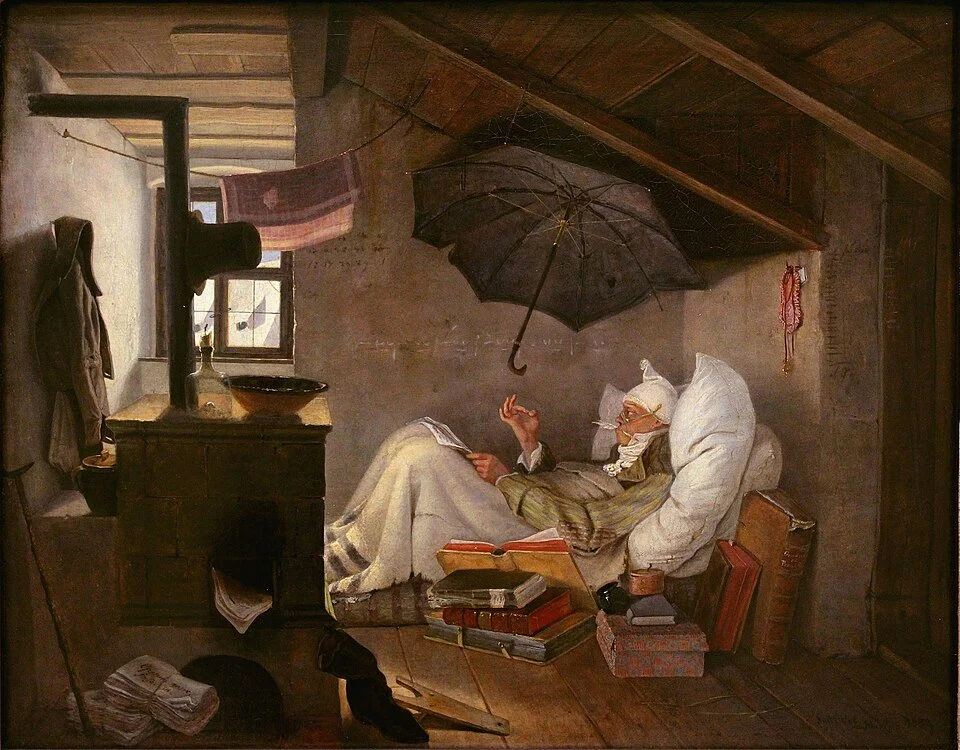
The Poor Poet, 1839 by Carl Spitzweg
This painting is one that comes up when you search for starving artist, and it invokes many of the thoughts and images that still to this day impact artist and creative people.
The starving artist mythos is one that has been around for almost 200 years from the time of our painting and boosted during a period in the end of the 1800s and early 1900. Many credit the book, Scènes de la vie de bohème, by Henri Murger (alt sp. Merger) for the romanization of the Starving artist trope, with the novel that would inspire Puccini’s La Bohème. This play and the novel romanticize a time where creatives and artists are living in abject poverty and destitution, creating and suffering for their art. Van Gogh, Vermeer, and Pablo Picasso and Paris often frame many of the starting points of the traditional visuals and mysteries of the Starving artist. This background has set up a legacy of expectations ideas and impacts that almost 200 years later still impact us.
How Starving Artist Mythos resonates today?
The community
“Whats your day job?”
“Are you able to make a living doing this?”,
“I wish I could afford to be creative!”
“How’s that going?”
All these quotes are ones that creative people and artist will have heard on a reoccurring basis in markets, at shows, in conversations and whenever introducing themselves. As a society we will in most new encounters, say our name and what we do for an occupation as the second thing when meeting new people. Questions, about how people who identify as creatives or artistic careers, survive financially seem to be one of the most common follow up questions. We have a bias, and potential reality, when we hear about artists, or creative careers, that these are roles, are often poorly paid, and not lucrative careers. Rightly so as in many cases artists and creatives will generally be below the average salary in many countries.
The starving artist mythos haunts our daily perception and that of artists, still very much today. For the common consumer the civilian there is a perception that artistic and creative works cannot provide a living beyond the wildly successful. It drives a sense of low value in the artistic and lends itself to both undervalue the time spend in artistic work as well as set an expectation of low effort and cost. How many artists have been told their prices are too high, or have a person react to a price set with shock. This shock and expectation are in part set in the common consumers mind due to a lack of knowledge of the artistic process as well as a societal norm that artistic work alone isn’t one that has value in financial form.
No one asks the questions above of doctors and dentists and their prices because we know they are high, and we accept that the years spent in study manifest the skills that drive a high price. This is not the case of artists who can spend the same amount of time studying but aside from a lucky few ever be able to command the same prices for their work. The picture of The Poor Poet has over the years crept into our image of artists and creative professions as a societal cliché and helped frame the common expectation that being an artist, is a profession that will be poorly paid.
The Artist, Self
Let’s go briefly back to our painting, our poet. He sits focused on his mattress, packed warmly against the chill and cold, focused on quill and paper, creating his next work. Intent, on driving into the next words his passion and expression his thoughts, dreams, imagination, and vision. The creation is the goal, and his stoic determination shows in his eyes and his surroundings. Specifically, the surrounds bear mentioning since he’s also sitting in a rooftop garret, his fire has gone out fueled by his less successful works, and around him aside from a meager collection of books, he clearly is not by any financial definition successful. He is poor as the title of the painting bluntly puts it. But why is he poor, is a question we can ask.
The Starving artist mythos brings with it a common and reoccurring set of themes that help us answer that question and connects them to the community in which we put our art. These themes are sacrifice, suffering and the Sellout.
Sacrifice
Sacrifice is an interesting word, but one that keeps coming back up in the reading done for this article. It sits at the heart of our poet, and the understanding of our community’s core understanding of being an artist. The desire, the choice to be an artist, in the common perception is one of sacrifice. To choose to create art, to make things, to develop a voice, the person chooses to face weak financial opportunities, to not have the same access to social security, retirement, holiday time and parental leave, and many of the more common benefits that conventionally employed people have access too. The decision to be an artist, is believed to be a decision to choose hardship, hence sacrifice.
On the flip side of this, we see the indoctrination of a society that believes in the starving artist, we often hear from the artist themselves that believe that sacrifice validates the art they create. That sacrifice of finances, of retirement, and holidays is a necessary part of the art they create because without it the art may lack meaning. The artist by choice of being an artist, may see themselves as having to sacrifice.
Suffering
Where sacrifice in this context is the implied conscious choice to give up certain things, for the art, suffering is a different beast. Suffering is often spoken of as a driver of creativity, inspiration, conceptualization, and artistry in its purest form. The suffering of an artist has been at the heart of many stories of our greatest artworks and creations, and while many suffer for reasons that are not their choice, the implied need for some suffering to exists for art to be created is a trope that continues. The romanticization of suffering in art is a trope we see in media all the time, the drunk musician, the haunted writer, the improvised painter, etc.
The belief that the starving in starving artist, is a literal driver of creativity is a commonly self-inflicted, and community driven. Making our artist in many causes need to be seen and see their situations of want and need be part of being an artist. Belief that they belong in that situation because it feeds their creativity and lets them create, also means that the drive to remedy suffering may be less wanted or even desired.
The Sellout
The final element in our analysis of the impacts of a starving artist mythos and its modern impacts, we’ve decided to call the sellout. Social groups of any type, shape, culture create their own unwritten rules. Within these rules, norms, guidelines, trends, dress codes and beliefs, we have an expectation that anyone that identifies with this social group they will abide within reason to the expectations. It’s these rules that often drive a group or culture to shame or ostracize those that don’t meet the expectations of a community. This is what drives the call of Sellout to those within an artistic community that find commercial success. We often see this with musicians that find success as having strayed from their roots, or exploited their background, they lost their sound or turned their back on the true path.
While that can absolutely be the case, our point is that this calling out, and condemnation of a member of a given community for their success shows the previous, sacrifice and suffering mentalities. The community has built these into their rules, and expectations of their group meaning those that find success or prioritize those goals will have in a way rejected or challenged the communities self-imposed belief of suffering and sacrifice. Creating the need to label them as outsiders, sellouts. We are starving artists, and anyone not starving can’t be an artist?
Can we feed the starving artist?
A mentality two hundred years in the making is still very much deeply buried in our societies collective view of artists, and still set in the mindset of our artists, as well. Now what can we do, how do we work to mitigate the impact of a society that believes that artistic work inherently isn’t as valuable, and a artistic community that either believes or accepts that sacrifice, and suffering are part of the job, and equally seeks to downplay those that defy these expectations. Education and Cultural change lay at the heart of what we believe can lead to change in this space and work to feed our starving artists.
Outlook and attitude
Creativity and artistry are skills as much as any that our society value, be it software programming or laying bricks. Why would we expect one to be poorly paid and another highly valued. It comes to how we as a community see and value the work. Having our communities value the art more starts by discussing the value of artistry and creativity. This means open discussions on the value of art, of creativity and its importance in society. We all in this community know that it’s important but we need to take every opportunity to educate and explain how this is a skill, it’s work on equal footing to any other and worthy of respect, value, and compensation. By drawing parallels with existing and understood crafts we can elevate artist work to the same level as many other trades and crafts. We should look to do this both in the community by making artist feel proud of their work and establishing an expectation that the work is valuable but to the artist and society. When we start setting the expectation from ourselves, we push that into society and with society raising the bar and expecting our artists to be paid a living wage we solve two problems. Addressing the internally implied need for poverty and working on the society belief of poor artists.
Celebrate the successful artists in our mists. Learn their lessons while ensuring your voice and media stays true to you own artistry. To see in their success the path to your own, while those successful in the community working to elevate and share that success to the community by engaging and using their position to increase awareness of arts importance and artists, collective position. A collective raising of our value and work will benefit all.
Education and understanding
As with most things in life, education and knowledge form the second branch of change. Many and possibly most of the conventional paths to a career in art and creative work don’t prepare the student for life as a solo entrepreneur. We’re aware of how that’s a bad word but let’s take the Band-Aid off right now. Artists and creative people are entrepreneurs, maybe only part time but self-employed is a reality for most. The reality of that is that many skills needed for an entrepreneur are not trained or even realized when a career choice is made. Setting a budget, pricing, self-marketing, customer service etc. are all bad words in most conversations about art and that is a problem.
Increased training and financial literacy would benefit any entrepreneur and especially artists. Making these lessons and training available to the community will directly have a benefit.
As well as the collective de-stigmatization of art, creative work being a business does will also help educate society and community that the work has value and should be properly compensated.
Summary
Starving Artists still exists two hundred years later, both as a mythos and a reality. Both imposed by our society by not putting value on the work done by artists, and the self-imposed expectations of artists themselves. Seeing sacrifice and suffering necessary components of the creative process, while denying the success of their fellows.
We must work to challenge this expectation and understanding in our culture to ensure that this work is valued in the same way as any other and that our artists represent creativity made manifest just as a brick layers wall, and a computer programmers app. Elevate and educate our artists, to set for themselves an expectation of a living wage and realization that suffering for suffering sake may not be necessary in the creative process.
We love our artists and wish them success to continue to creatively drive challenge and expand our awareness and view of the world.
If you want to review your value or develop your financial literacy, reach out to us directly on our email (timh@department45.eu) or on our Instagram . Please share you experiences in the comment section below.
THANK YOU!