Payment Systems and Getting Paid
Hard work is over!
It doesn’t matter if you’re selling your art and services from a fixed location like a store or studio, or standing in a market stall as a vendor, there is always a point after the hard work of selling is done that you need to collect that money. Time to get that money from them to you, and how you do that and what methods of payment you’re able to take and what is costs you to collect can be very important for you as a seller, vendor, and business.
This article we will review the methods of payment, what is more common than others, and analyze the current most common payment methods platforms and tools. All this to give you as a seller the best mix of tools and resources to ensure you’re ready to collect from any customer in any situation, because nothing is more frustrating than struggling to get paid after doing the sale.
We want to give the best possible mix of solutions to ensure that you’re ready to receive the widest range of payments and do so effectively.
The specific scenario this article looks to address is the one-off having a need to collect a payment live, and or in person. We’re not tackling the online shopping experience in this article so while we will be looking at online means of taking payment. It will be in the context of a mobile payment. We’re not debating the virtues of online shopping store fronts tools suites. This might be the subject of a future article but not this one.
Getting Paid and Methods
We’ve sold and item or service we’ve completed the necessary negotiation and task and now need to get that final sweet task completed which is payment. So how do we do this and how to we get ready to get paid. In some cases, you need to be prepared to receive payments, and do some work to make getting paid quick easy and simple. So, lets first look at methods of payment and talk a little about them.
We outline the payments in the following three buckets.
- Cash
- Cards
- Online and Mobile
Cash
Cash is often king and has been a part of our system for thousands of years. Being able to take cash, having spare change is a great baseline for any market vendor or store front. In many cases it’s the most basic way of getting paid even though it’s becoming more and more rare. Some studies show that about 59% of transactions are in cash now, and this number is declining more and more as time goes on, in favor of cards and contactless payments. Being able to take cash however is unlikely to go away and is often necessary for basic and simple transactions. So key things to consider if you’re going to take cash as a payment method. First you should consider, who you’re selling too and what you’re selling. If you’re selling in local markets with many locals or if your products are a relatively low-cost product having cash makes more sense. Many customers may consider cash for small transactions under say 10€. Having cash to take payments for these smaller items is a good idea and something to be ready for. Additionally, if you are selling in market or flea market environments, cash payments have a legacy trend to be more common.
Preparing to take cash and make change you as a vendor need to consider two things. Firstly, spare change, do you have enough spare change to give back on a given larger bill. Do you have enough change to do this several times in line with your sales expectations. You may need to go to the bank to get some coins and small denomination bills to prepare for the spare change. Additionally keep in mind that cash is easy to take and steal. You should ensure you have a good method of storing and securing your cash. This can be on your person and hidden and if you have a larger amount of cash available this might be good to ensure a way to secure it in a locked or secured strong box or in a car or similar. Taking cash should always be an option for you if you’re market vending and should be something you have prepared for.
Cash presents the fastest and more tangible way to get a return on goods and services and for that reason it is still common to see it in markets. The benefit to being paid cash in hand is to not be underestimated. However as mentioned clients across the board are using cash less and less due to reasons of simplicity and convinced. And that’s why we need to be ready to get paid in other means and methods.
A quick thought on foreign currency and cash. You may be in a location that sees many tourists and, in some cases, may be marketing specifically for this very lucrative client base. In that case you may have a client that wants to pay in a foreign currency. In that case you need to decide if you’re happy to receive this and additionally what you want to evaluate that currency value at. If you want to reject foreign currency entirely that makes sense and is not wrong, however if a customer wants to pay in dollars, Swiss francs or similar it may be a bold step to tell the customer ok but at an advantageous exchange rate for you. Look up existing exchange rates now of an interaction like this and consider it carefully.
Card
Previously we mentioned that 59 percent of transactions in Europe are done with cash, and this number is declining, cards represent 34%, with a value that is increasing consistently and expected to take over cash payments in the not far future. Now how do we get paid by card, cards can be tricky as these now introduce the additional wrinkle and security that includes, banking. This therefore means that you often need to have more equipment or tools to received card payments, most commonly in a specific piece of hardware.
Having a point of sale (POS) tool, like an actual card terminal that you can get from your bank, or some online services can give you the easy means to take any card. These banks issued terminals come are a paid service from your bank which you can subscribe too. This type of service will have costs both in monthly or transactional fees and are great options for those that use a lot of transactions, in the thousands of monthly transactions. Otherwise, some online services such as Square can support with a small configurable terminal that provides contactless, and card payment options. These also come with transaction fees and subscriptions however these can be more affordable in small scale then bank offered terminals.
Having a terminal that can take payments is a great tool to increase your availability to take payments, as this opens you up to taking debit cards, credit card, and foreign cards from our ever-present tourists. The balance of costs of having the terminal and the frequency of use will need to be carefully considered, however with the increased presence of cards in the payment field having this will make you more able to engage in more customers quicker and simpler.
Additionally, the bank transfers issued by cards are a great way to ensure that payments go directly to your account saving you the need to deposit cash and keeps your transactions simple and clean.
Online and Mobile
The last group of payment methods are a bit of a hybrid category as these are either bank account to bank account payments or card payments facilitated via an online vendor, think PayPal or Revolute. The core of this method is using your phone or similar device and the customer device you’re able to move the payment in a way that doesn’t need more hardware like the point of sale mentioned above. Some examples of these tools are for example.
- MB WAY – Portuguese point to point phone number-based bank transactions
- Revolute – A third party service side that facilitate movement of funds from one members account to another account within their own system. Funds are transferred to and from the revolute wallet from traditional bank accounts.
- PayPal – this site can both host a bank account for the seller and buy and set up card payments directly to those accounts from buyers to sellers directly and as a payment site for one off card payments.
Each of these tools fall into similar buckets where key things to note are they enable the seller to set up either a direct point to point transfer of funds (MBWAY) or allow for a service enabled tool to send funds via a card payment through the browser or a in service system transfer of funds from one account to another (Revolute). Each tool effectively gives the seller the ability to take payments from different methods with some preparation and setup.
The preparation for use of a given service and there are multiple different vendors that work similar. Note that most of these services may have charges or costs related to transfers or to get the funds out transferred to your normal bank. It’s important to be careful with 3rd party vendors and services as these are not traditional banks and are often not covered by the same rules, regulations and security requirements traditional banks are covered by.
Having a mobile means method or several to allow for quick transfers is a huge opportunity that means with the right setups and services you’ll be able to take card payments or MB Way point to point payments.
Having your card ready services set up on your phone and having some spare change in your pocket you should be ready to approach customers foreign, and local with any of a range of payment options.
CASH or Card?
Now we have discussed methods and pros and cons, what would we now recommend. Based on the above discussion and analysis we have here below in detail, we recommend keeping few options available. Cash, MB Way and Revolute seem to be a good way to enable the widest range of payment options for the least upfront investment. Cash is self-explanatory and should always be available, MB Way lets you take payments from any Portuguese bank account, finally revolute has a means to receive payments from that application as well to have a credit card payment made directly to that account.
With this combination of resources, you can take cash, cards and MB Way payments, with minimal cost all via your own mobile phone. It keeps the cost of doing business low while making you accessible to most possible customers.
Having a good knowledge of how revolute works to ensure quick credit card payment set up would allow this to be simply offered as would displaying clearly how you can get paid in your vendor stall. Showing your revolute QR code and MB Way phone number will make it clear and easy to see how buyers can interact with you.
If you want more details, please read the analysis that goes in depth of the different methods mention below.
If you’re just starting out selling at markets or are wondering if your prices are working for you please take a look at our other articles on our site here, (department45.eu) or follow us on our Instagram. We would be keen to work with you on developing your small business further.
Analysis of Methods and Solutions
Let’s now review some of the most common solutions specifically in the Portuguese market and see what criteria are needed to be ready to use them along with costs, service subscriptions infrastructure or tools you might need to set these up.
We’ll be looking at options that run the gambit of payment methods mentioned above and should set up us to allow a vendor to receive any of a range of payment methods.
We will be investigating a selection of specific options where we will discuss specific infrastructure and costs associated with giving you the ability to take the payment method.
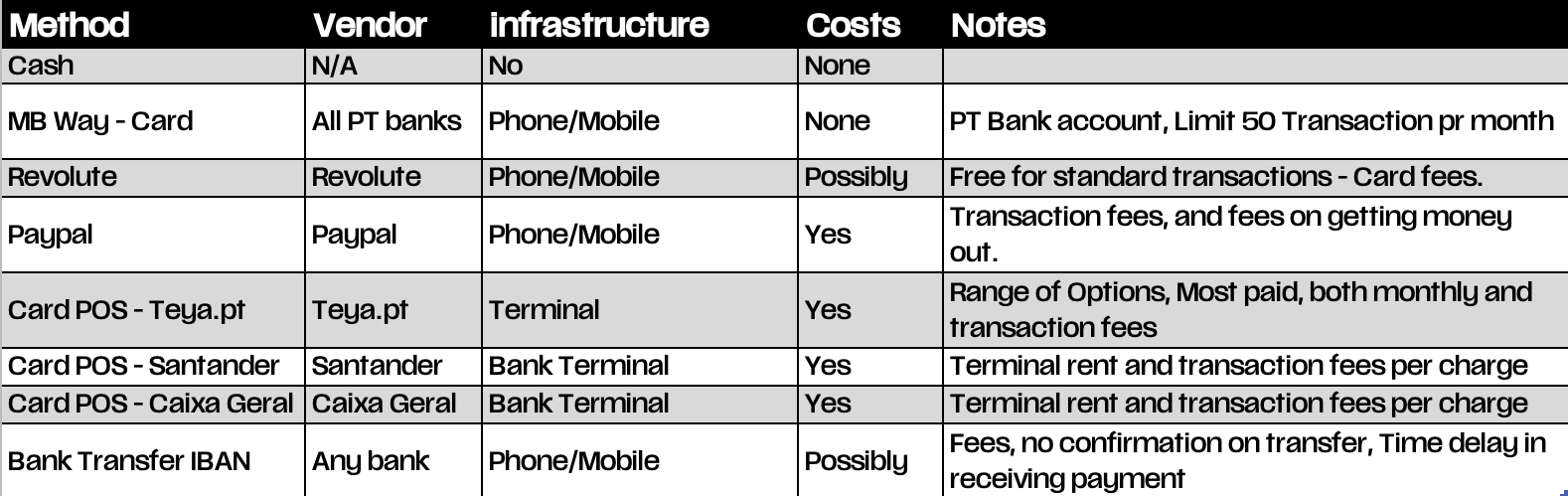
Methods
Cash
We discussed cash earlier in this article and it’s clear that cash has the advantage in speed of transaction, the fastest way to get you paid, and flexibility since cash is still commonly used in Europe. However, as payments become more online, and card based having cash only as a payment option gives a lot of room for losing clients. Additionally having a reduction in ATMs in many towns getting cash when you need it is not as easily done as possibly in the past. Having cash as an option seems like a clear requirement but making it your only method is going to be a limitation on your business and lose you sales. Now to take cash you need to have spare change, coins, and low denomination bills, make sure you have some spare change to take a payment and pay attention to this when starting a market or sales day.
Summary: Always be able to take cash but don’t make it your only method
MB Way – Card
MB Way is a Portugal wide based point to point transaction system that lets you send receive and pay money directly from the bank account linked to the phone number. This is sent to the receivers account directly and instantly. This is available to all people with a Portuguese bank account, however limited to Portuguese bank accounts. Additionally, it requires internet connection and has limitation in how many transactions you can make with a normal user account. As a vendor the key limitations to consider is that you can receive up to 50 transactions a month and collectively 5000 euro. Should you need to expand beyond these two limitations in both number of transitions then you should speak to your bank as they may have better options for you. These services are free currently as of this writing to use when enabled and set up, so MB Way is a great way to be able to receive payments and one that we suggest any vendor in Portugal have ready and set up. Over 40 % of online payments are happening with MB Way so this will clearly be a growing part of any payment portfolio.
Summary: Always have MB Way options available for PT customers.
Revolute – Card/service Payment
Revolute we spoke about briefly above is a Financial technology service that requires users to specifically apply and subscribe too. They are effectively a 3rd party that users, both sellers and vendors send money too from their traditional bank accounts and then with the money in a Revolute account allows you to use Revolute to transfer funds from the revolute account to another user’s revolute account. This transaction is done instantly on the service, however, to get that money into your traditional bank account can take extra steps and time, as Revolute will need to send that money to your bank. As for costs Revolute set up is free, and sending money between revolute standard users, is also free, within the EU. Note that American users might see a fee if paying here in Portugal. Additionally revolute has a means to via the website to allow a customer to pay with a card to your revolute account. This means the buyer effectively pays directly with their credit card to the revolute account. This however does have a cost in transaction fees. According to media reports, revolute is increasing is user base in Portugal so having this option and being familiar with it might be a valuable addition to set up. Make sure your familiar with the website and know how to quickly enable a pay request as this will simplify your payment experience.
Summary: Having revolute and keeping it a free service makes it an attractive means to be able to receive payment. The extra steps needed to get the money into your traditional bank account can be a challenge.
PayPal – Service and Card payments
PayPal is an old dog online in the payments space and one of the first payment services established to do and send funds. The keynote here is that this is a digital wallet in the same manner as Revolute, where you’ll need to have an account/wallet ready to allow for payments. PayPal will in many instances look for fees and costs to be applied to be used for most payments, outside of friends and family. Any currency differences will also apply fees. PayPal does allow for card payments made via the application to your digital wallet but again fees are here for the buyer in this case of a card payment. Finally, and probably most egregious is the fee that may apply to get your money out of the digital wallet and put into your traditional bank account. This fee can be of several percent of the actual amount.
PayPal is an old dog in the payment space and has advantages for those users that have large online presence or need to send/receive many payments. However, I don’t think it is well suited for the market vendor or the intermittent vendor.
Summary: Skip PayPal as other applications can do more and better and the fees here are a heavy tax for minimal additional value.
Teya.pt – Point of Sale
There is a service solution coming up that provides both the infrastructure and the service to take card payments in a manner traditionally provided by banks. Teya.pt is one such company that offers a means to take card payments via a point-of-sale tool (POS) This is a handheld device that you’ll be familiar with from any card payment in stores. This device is either rented for a monthly subscription or bought outright from Teya and then used to facilitate payments in the same manner as other card terminals are used. Teya additionally takes a transaction fee for the service when using cards. This can be up to 2.5% of the purchase price when using the free android only options, vs. 1.5% on the terminal payments. The ability to easily take payments in a familiar way with a receipt is an interesting perspective however the monthly and transaction fee costs need to be balanced. If your business has many sales or you’re doing markets/vendors
Summary: Usage of a 3rd party non-bank terminal can be a good starting point when your business is growing to the point where MB Way is not enough for cards and the hassle of other online payment methods is too great. The commitment and risk with a monthly cost from Teya.pt is less than the traditional banks and provides a way to explore this option should you be getting to the point where many transactions are coming in.
Bank Point of Sale – Santander & Caxia Geral.
Now let’s look at our traditional banks with their traditional terminals. These will be familiar to most buyers and vendors as this is the most common way of receiving card payments in stores. Most vendors will have selected one partner for their terminals and the bank then sets up both the business account and provides the terminals to the vendor. We will look at two different big banks in Portugal to see their costs and fees.
Both banks offer a range of services and deliver with their status as banks probably the strongest security and regulations due to government regulations. However, they also get paid for that. The terminal rents for Santander can vary depending on the contract type signed between 25€ to 50€ with the ever-present card transactions fees added to each transition. Caixa Geral also has monthly rental costs and transaction fees however are not so kind at to state what those values are. We can assume they are not dissimilar. Keep in mind that other fees and costs can be buried in then fine text. Things like cancellation fees, late fees or account fees could make the math in having the terminal change significantly.
However, you will be getting the best security speed, and flexibility in receiving payments by card. The bank terminal will allow for MB WAY QR code payments which is an additional feature making these terminals a bit more flexible than those provided by non-bank vendors like Teya.pt.
The costs of support and the overall transaction volume of sales will need to be clearly considered in planning to take onboard the costs and fees related to taking payments via a traditional bank terminal.
Summary: The peak of payment systems must be the Bank support terminal if you‘re at a stage where your volume of sales transactions and the costs associated with it can carry the cost, then it makes sense to ensure the money is going directly to your main account. I feel this would be a goal to work towards and not a starting point as the costs can be excessive if sales are limited or only growing. Build up to the bank terminal, if other card options don’t work or are not secure enough.
Bank transfers – IBAN transfers.
Our last method to analyze is the possibility of using a normal account to account bank transfer. Probably the slowest and clunkiest system where the buyer using their bank app, requests a transfer of funds to the seller’s account. This first requires a lot of information, from both seller and buyer, IBAN number, SWIFT codes, and commonly the buyer’s full name. Typing this all in while in a sales process along with making sure it happens is not ideal. The seller is dependent on confirmation from the buyer that funds have been sent, as only the seller would generally be able to confirm sending as no notification is sent the seller. Timing is an issue as well; bank transfers can take several days to land in the account. This means if buyer made a mistake Seller won’t know. They will have to keep an eye on the account to hope the funds arrive, risking the situation the buyer got the product for free. Mistakes happen and this is the messiest way to transfer money. Finally, it’s not free, many bank-to-bank transfers can have fees. International transfers will almost always have fees, currency exchanges fees can apply, and these will be paid by buyer most likely making the cost greater.
Summary: We don’t recommend making IBAN transfers and options and suggest that sales where this is a risk move to cash options if nothing else is available as the risk is too great for errors and issues, due to the delay in transfer and a lack of confirmation of transfer.