The E-Myth Revisited - Book Review
Welcome to series two of Department 45’s small business book reviews. After our first round of book reviews, focused on recommendations and quality resources for small businesses in the art and creative business space. We decided that we wanted to do the second season or series, on more core small business advisory books. The books we originally looked at in series one was focused on Art and creative businesses with a focus on making that specific business segment successful. The books in our second series are some of the most highly recommended and referred results when looking for small business books.
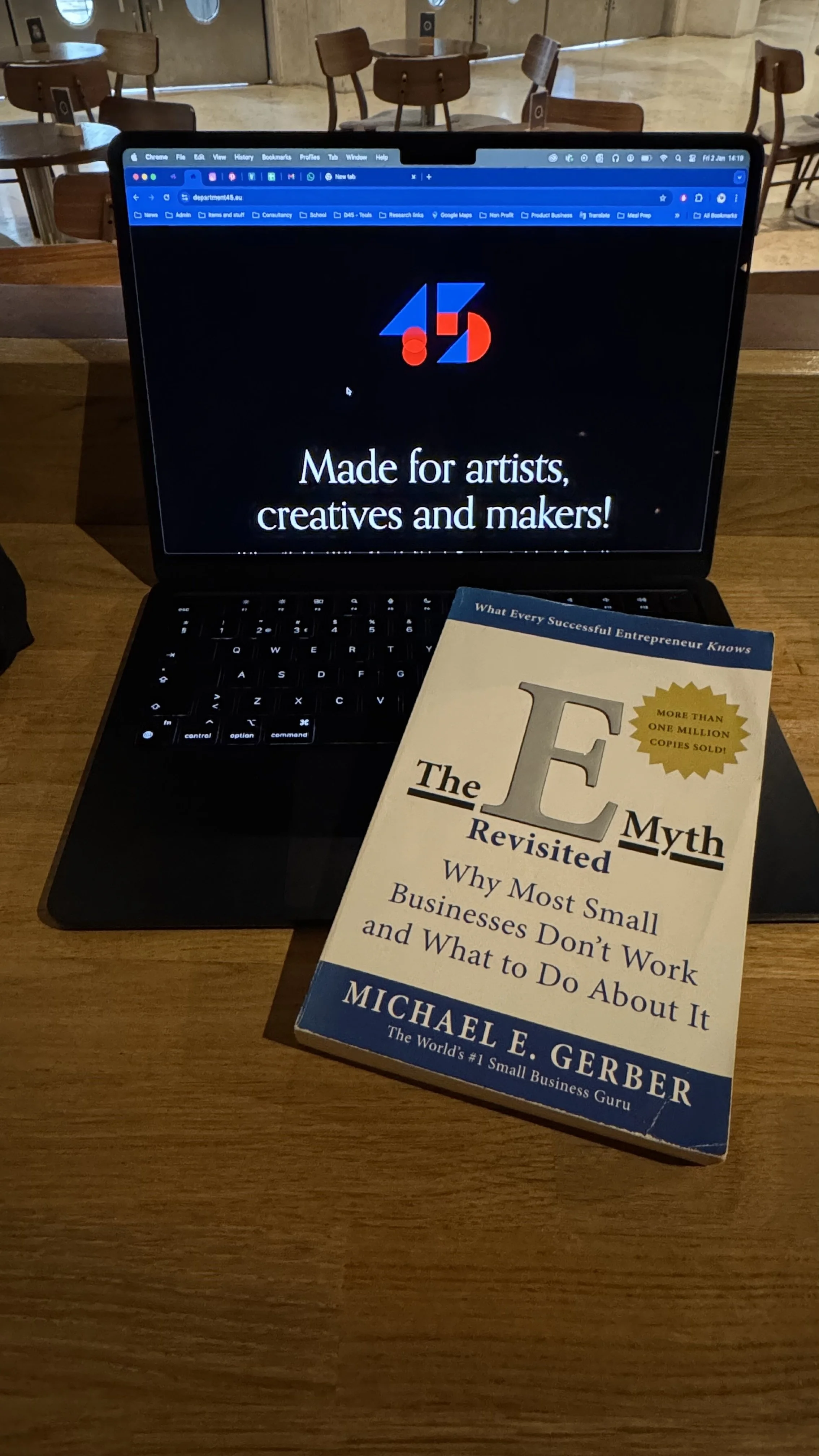
The E-Myth revisited is one of the most recommended and referred and in its own front cover has multiple blurbs, claiming more than one million copies sold, “What Every successful Entrepreneur knows” and under the authors, Michael E. Gerber credit, the statement “The Worlds #1 Small Business Guru” So naturally this was a must read for us.
The logic in applying a review series to general and more common business themed books was to look at our art and creative businesses as businesses too. While the line of business is important and contains contextual nuance. Many common business themes, and ideas will apply across all lines of business, and have meaning across the board. That’s what we’re hoping to identify with this series, and we will both be reviewing the books for their general content as well as their applicability to the Art and Creative Business space.
The E-Myth revisited was first published in 1995, so contextually it’s an old book and most likely older than many of its readers, additionally the context and knowledge that the author Michael Gerber has developed this from is even older than that. With much of his experience coming from the 60s through to the time of writing the book. So do we have a series of universal wisdom that resonate from a day and age that is pre internet?
Content
The book is written in three parts, the first that discusses the nature of American entrepreneurship, it’s place in American history and the authors idea of what is going on at the time of writing (1995). The second section is a discussion of Turnkey businesses, as some form of new businesses, and turnkey for those that don’t know is effectively franchise businesses, Think McDonalds, Subway, etc. and then the third section is a more hands on discussion of how you should think of and build a small business according to the author.
As for the content, I have to say that Most of the first and second sections, are barely relevant. With some few observations in between, that resonate in my own experience, I find the way that the ideas and content to be delivered in a way that is very off putting and didn’t engage me at all.
A key point that I did appreciate in the first section, spoke of how some businesses are operated by what the author calls technicians, or people who have a key skill, hairdressers, carpenters, electricians, consultants, ceramicists, etc. These technicians, that both run the business, and do the work of the business often find themselves struggling to separate the work of delivering the business and the business itself. This key differentiation is one of the few valuable elements highlighted in this otherwise confusing book. That it is key to the success of the business to not only deliver a product be that your skills, or a physical product but also to take time and energy to build a business of that product. It’s not enough to do great nails in your nail bar, you need to market the business, you need to hire the right staff, negotiate the right prices with suppliers etc. He warns the technicians to not lose their business with a focus on product only as that can be at times not enough. This is valuable information.
The second section where he effectively praises the franchise business model, where you effectively take a whole business model as a product and saying how that is a superior way of thinking is interesting, in thought only but barely relevant to any of my readers and I’m not sure if this holds up to scrutiny in a 2026 economy. The book shows its age in this section, significantly.
The third section, Building a small business that works, is more hands on with details, and tasks that can help outline the framework, that many people will often overlook or not know to to when building a business. It’s comprehensive in some areas and lacking in some others in my opinion, however the general idea of thinking of your business as both product and processes naturally made me happy as it speaks to both my own experience and understanding. A key perspective mentioned Is how critical training of staff, having processes and procedures are, how ensuring consistent quality and delivery of experience and product are to a successful customer experience is very true. This section can have value when you are starting up your business. The issue I have with the third section however in my opinion puts an emphasis on growth and size over sustainability. The premise of the author is that you should be thinking of your business at a scale much larger than you may want too. You should be building for a large long term and preparing for that day one vs. more organic that I think is more realistic. The hard charging nature of the advice laid out isn’t wrong per say but it is potentially more then you need to do at the stage for most art business and creative business owners in my opinion.
For example, there is a whole org chart discussion that the sample business discussed in the book builds to have a dozen or so more roles, when there are only two employees. Now the book says we do this discussion in the beginning to prevent problems later which is great. It’s also wildly unnecessary for most small businesses. Is it good advice? Sure, is it necessary no.
The content messages of the book is mostly fine, if a bit out of date and not specifically applicable to Art business or creative businesses in my opinion. Now lets get to how this information is delivered.
Format
Usually, I write about the format and content in the same section as I believe they go hand in hand as information delivered is entirely dependent on the means and method it was delivered in. The book here falls flat with me, in its delivery. The author who I have no doubt is an experienced person uses a very weird means in which they discuss the ideas of the book. The author uses a fictional or semi fictional conversation with a client, Sarah, as a vehicle to discuss all the different chapters. This is very poorly articulated in the book. With very long parts of the book are the author, himself, is in a narrator speaking as himself, talking to Sarah, the owner of a Pie shop, that is failing. The author, narrator, talks in the first person, to Sarah and retells their conversation, which is fictional to illustrate the authors own points, or ideas.
The author just wrote a chapter, and then the author writes a conversation, that didn’t happen between the author and Sarah, in which the author says he’s very correct and smart. Sarah is often fascinated and clearly understand why the author is correct.
A major part of the book is given over to this weird conversation with Sarah, which does nothing to add to the ideas the author talks about in his book except seeming like some self-polishing of the authors and ideas.
The author even “tells” Sarah a rambling long and pointless backstory of himself, in a crazy 3rd person perspective, which frankly still pisses me off thinking about.
The way the author chooses to present his ideas don’t work for me and I think miss a lot of points and waste a lot of space rambling. Additionally, I think this distracts from what could be relevant topics. Additionally due to the bloat of this conversation, I think more space could be given to cement some of the more basic ideas the book glosses over.
Summary and relevance
As one of the most referred books in the small business space I must wonder why? While the content is there, the means it’s delivered is clearly not, for me at least. This book is part of a whole industry created by the author which I do believe has helped many people in their growth, I don’t see this having anything new to add for our art business and creative business owners. The size of your businesses, as well as the means in which books presents it’s ideas are out of date and not immediately relevant. I would suggest you look at other resources for better and more up to date content.
If you have a business idea you need fleshed out or want to review the financial structure of your company regarding pricing or similar, then please reach out to us on email at timh@department45.eu, or on our Instagram DMs and we’ll be thrilled to set you up with our free, introductory session where we can get to know each other and outline where we can help build your business into something that works for you.
Thank you,
Tim H.
Lead Consultant